ETF Accumulation vs Distribution: Which One Is Right for You?
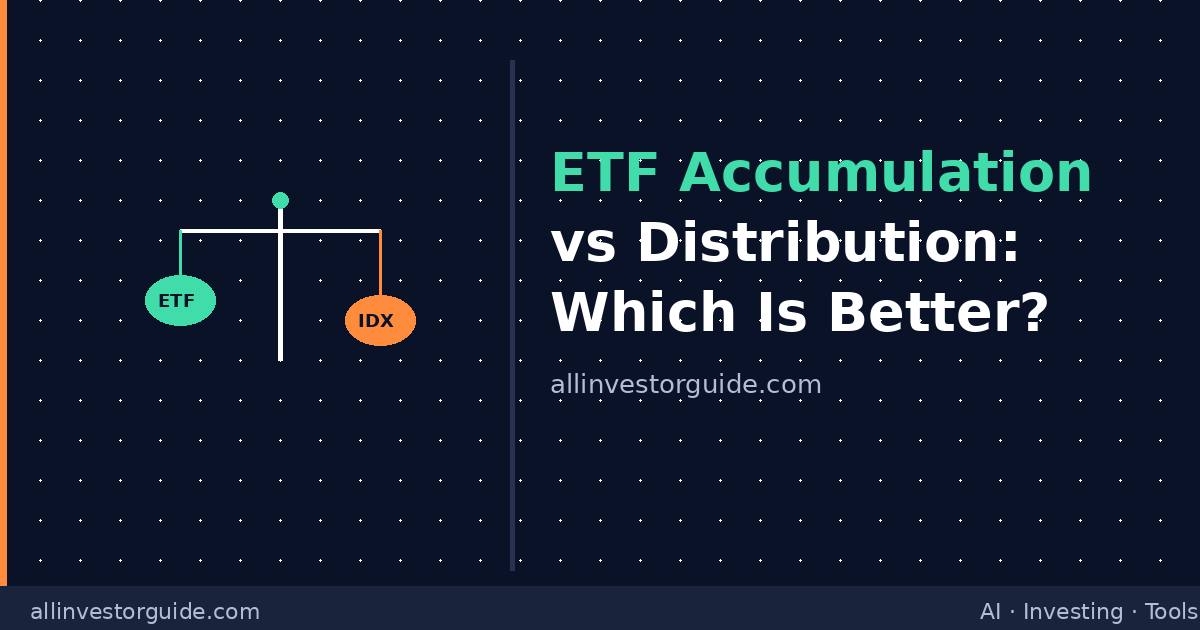
Understanding ETF accumulation vs distribution is one of the most overlooked but impactful decisions for long-term investors.
When you first come across this question, it feels like it should have a five-word answer.
It doesn’t. But it’s not complicated either.
ETF Accumulation vs Distribution: Which to ChooseOnce you get what’s actually happening inside each type of fund, the right choice for you usually becomes obvious. Let me walk you through it.
The Simplest Way to Think About ETF Accumulation vs Distribution
Same fund. Same index. Same companies inside. The only difference is what happens to dividends.
Accumulating ETF: The dividends get quietly reinvested back into the fund. You never see the cash. The value of your units just grows a little more each time.
ETF accumulation or distribution? Find out which suits your goals, tax situation and time horizon. Clear comparison with real examples.
That’s it. That’s the whole distinction.
What It Looks Like in Practice
Imagine you hold an ETF that tracks the MSCI World. Thousands of companies — Apple, Nestlé, Samsung, Johnson & Johnson — are all paying dividends throughout the year.
With a distributing fund, that money gets collected and sent to you. Quarterly usually, sometimes twice a year. Your number of units stays the same, but you’ve received cash. The fund price drops slightly on the day the dividend is paid — because the fund just paid out part of its value.
With an accumulating fund, that same cash gets reinvested immediately. No payout. Instead, each unit you own becomes worth a bit more. Quietly. Automatically. Without you doing anything.
Over one year, the difference is small. Over twenty years, it’s not.
The Tax Part — Because This Is Where It Actually Matters
Here’s the thing most comparisons skip over, or bury in footnotes.
In most countries, dividends are taxable income. And the timing of that tax bill changes the math significantly.
With a distributing ETF, every time you receive a dividend, you may owe tax on it that year. Say you receive €1,000 in dividends and you’re in the 21% tax bracket. You hand over €210 to the taxman. You’re left with €790 to reinvest.
With an accumulating ETF, that full €1,000 stays inside the fund, working. You’ll pay tax eventually — when you sell — but by then, that €210 has been compounding for years. In some countries, like Spain, accumulating ETFs defer the tax hit entirely until the point of sale.
That’s not a loophole. It’s just timing. But over a long investment horizon, it genuinely adds up.
The Admin Nobody Talks About
There’s a practical difference that doesn’t get much attention.
With a distributing fund, dividends hit your account as cash. If you want to reinvest — and if you’re a long-term investor, you usually do — you have to place a new buy order. Every time. Which means transaction costs, small amounts sitting uninvested for days, and a decision you have to make even when you’d rather not.
With an accumulating fund, this happens on its own. You don’t lift a finger.
It sounds minor. But removing friction from the reinvestment process is one of the genuinely free upgrades you can make to your investing setup. Fewer decisions means fewer chances to make the wrong one.
So When Does Distributing Make Sense?
Distributing ETFs aren’t worse. They’re just right for a different investor.
You need the income. If you’re retired or drawing down your portfolio, having cash arrive regularly — without needing to sell units — is genuinely useful. Predictable. Psychologically steadying during volatile markets.
You’re inside a tax-advantaged account. UK ISA, pension, retirement wrapper — somewhere dividends aren’t taxed. If that’s the case, the whole tax deferral argument goes away. Either fund works; pick whatever suits you.
You just prefer it. Some people like seeing money arrive. It makes the investment feel real in a way that watching a unit price slowly climb doesn’t. If that keeps you calm and invested during a rough market, it’s not irrational.
Your country taxes accumulating funds differently. Germany has a system that taxes accumulating ETFs on a deemed distribution basis each year. Belgium applies a different transaction tax. In those cases, the tax advantage may be smaller — or reversed. Always worth checking for your specific country.
And When Does Accumulating Make More Sense?
For most long-term investors outside a tax-advantaged account, accumulating is the default for a reason.
You’re still building wealth. You don’t need the cash now. The automatic compounding does its job without you having to manage it. And in most countries, you get to defer the tax bill until you actually sell — which, if you’re playing a long game, might be decades away.
The maths and the simplicity both point the same way.
Same ETF, Two Versions
Most major ETFs come in both versions. Vanguard FTSE All-World. iShares MSCI World. Amundi Prime Global. Same index, same holdings, same TER — just two different versions depending on what you want to happen with dividends.
You can usually tell by the name. Accumulating funds often say “Acc” in the title. Distributing ones say “Dist” or “Inc.” The ISIN will be different, even though everything else about the fund is essentially identical.
Three Questions to Help You Decide
Work through these in order.
Do you need the income right now? If yes — retired, living partly off dividends, need the cash flow — distributing makes sense. Stop here.
Are you in a tax-advantaged account? If yes — ISA, pension, tax-sheltered wrapper — the compounding advantage mostly disappears. Either works. Pick what’s simpler.
What’s your time horizon? Ten years or more? Accumulating almost always wins after tax. Under five years? The deferral advantage is smaller, and the straightforwardness of distributing might be worth more.
For most people reading this — building wealth, regular brokerage account, not yet near retirement — accumulating is the answer.
A Few Things People Get Wrong
“Accumulating means I avoid tax.” No. You still pay — just later, when you sell. The advantage is timing, not avoidance.
“I’m getting extra money with distributing.” You’re not. The dividend comes directly out of the fund’s value. On the day it’s paid, the price drops by exactly that amount. You’re receiving part of what was already yours — in a different form.
“The one with the higher yield is better.” Yield in isolation means nothing. Total return — price growth plus dividends combined — is what matters.
Use ChatGPT to Run the Numbers for Your Situation
If you want to see the actual difference in euros or dollars — for your tax rate, your country, your time horizon — this is a calculation ChatGPT handles well.
“I’m a tax resident in [country], investing outside a tax-advantaged account. I’m comparing an accumulating and a distributing version of the same ETF. Assuming a dividend yield of 2%, an average annual return of 7%, and an initial investment of [amount], show me the projected after-tax value of each after 10, 20, and 30 years. The dividend tax rate in my country is approximately [X]%.”
The output won’t be a legally binding tax calculation. But it will show you the rough magnitude of the difference — and for most long-term investors, seeing that number settles the question faster than reading another comparison article. Including this one.
The Short Version
Accumulating ETFs reinvest dividends automatically and defer the tax hit until you sell. Best for most long-term investors outside tax-advantaged accounts.
Distributing ETFs pay dividends in cash. Best for people who need regular income, or who are inside a wrapper where dividends aren’t taxed.
Same underlying investment. Very different experience.
For most people still building wealth — accumulating wins. Not dramatically, not every year. But quietly and consistently, which is exactly how compounding works.
Nothing in this article is financial advice. Tax treatment varies by country and changes over time. Always verify with a qualified professional before making decisions based on tax considerations.
For deeper research: ETF Explained — Investopedia and Fund Research — Morningstar.
You Might Also Like
- 10 ChatGPT Prompts to Analyze Any ETF in Minutes
- Index Funds vs ETFs: What AI Tools Say About Each
- Best AI Tools for Investors in 2026 (Tested & Ranked)
In summary, mastering ETF accumulation vs distribution is one of the most valuable skills a modern investor can develop. Using ETF accumulation vs distribution regularly helps you make smarter, data-driven investment decisions. With ETF accumulation vs distribution, you can evaluate more opportunities in less time and with greater depth. Every time you apply ETF accumulation vs distribution, you sharpen your ability to spot real investment value. Incorporating ETF accumulation vs distribution into your investing routine will pay dividends over the long run.